
How Much Do You Really Know About Food-Grade SUS304 Stainless Steel? | Dasin News and Events | Made in Taiwan Commercial Juicers & Shaking Machines for Beverages and Drinks Manufacturer | Dasin Machinery Co., Ltd.
Dasin How Much Do You Really Know About Food-Grade SUS304 Stainless Steel?. Dasin - Specializes in assisting beverage shops, bubble tea shops, juice shops, restaurants, etc., providing beverage and juice making machine.. Dasin Machinery is located in Caotun, Nantou, Taiwan, which is a professional manufacturer of food machinery. Our company was called Shengfa Food Machinery in early times, which started to produce commercial juicers and do OEM since 1975. We continually accumulate our experience in OEM and ODM. Meanwhile we constantly develop new products to fulfill the needs of our customers.
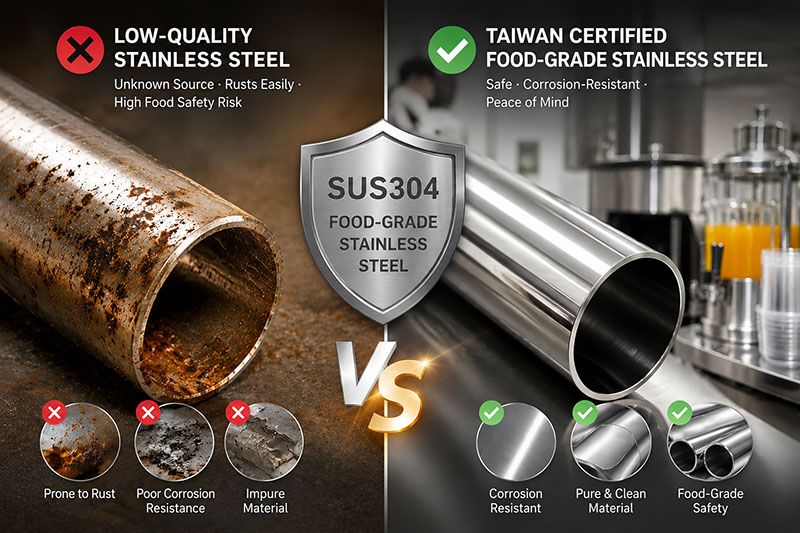
How Much Do You Really Know About Food-Grade SUS304 Stainless Steel?
In recent years, food safety has become an increasingly important issue, especially for food machinery, beverage equipment, and catering appliances that come into direct contact with drinks, ingredients, and high-temperature environments every day.
Many people assume that as long as a product is labeled “304 stainless steel,” it is automatically safe. However, the truth is:
Food-grade stainless steel is far more than simply having “304” printed on it.
What Is SUS304?
SUS304 is one of the most commonly used stainless steel materials in the food equipment and food service industries.
Its primary components include:
Chromium (Cr)
Nickel (Ni)
These elements provide stainless steel with:
Excellent corrosion resistance
Acid and alkali resistance
Strong anti-rust properties
Suitability for food contact applications
As a result, properly certified SUS304 is widely used in:
Beverage equipment
Food processing machinery
Medical equipment
Kitchen utensils
Food containers
How Is Food-Grade Stainless Steel Classified?
Food-grade stainless steel is not just about having “304” stamped on it.
Many people believe that:
“If it says 304 stainless steel, it must be safe.”
Or even:
“All stainless steel is food-grade.”
In reality, this is not true.
True food-grade stainless steel is determined not only by its grade, but also by several critical factors:
1. Stable Chemical Composition
Stable chromium and nickel ratios are essential.
2. Compliance with Food Contact Safety Standards
The material should meet food-contact safety requirements.
3. Heavy Metal Testing
It should comply with heavy metal migration standards.
4. Acid and Corrosion Resistance
High-quality stainless steel must withstand acidic and corrosive environments.
5. Clear Material Traceability
Reliable material sourcing and traceability are important.
Common materials used in food equipment include:
SUS304
SUS316 (higher corrosion resistance)
However, some low-cost products may use:
201 stainless steel
High-manganese steel
Low-grade recycled steel
Although these materials may look similar on the surface, the differences in durability and food safety can be significant.
If low-grade or unknown-source stainless steel is used, long-term contact with hot beverages, acidic drinks, tea, or food may lead to material degradation and food safety concerns.
Since food equipment directly contacts what consumers eat and drink every day, material safety should never be judged by price alone.
Why Does Some “304 Stainless Steel” Still Rust?
Many people wonder:
“If it’s 304 stainless steel, why does it still rust?”
There are several possible reasons:
1. Impure Material Composition
Some low-cost products may not use genuine SUS304, but instead:
Insufficient material composition
Low nickel content
Inferior substitute materials
While the appearance may look similar, the corrosion resistance can be dramatically different.
2. Use of Recycled Steel
Unknown-source recycled steel may contain impurities and unstable metal components, making it more vulnerable to corrosion when exposed to acidic beverages over time.
3. Prolonged Exposure to Salt or Acidic Environments
Even genuine SUS304 may develop surface rust if exposed to high salt or acidic conditions for extended periods without proper cleaning.
Therefore:
“True food-grade quality is not just about the label — it’s about the overall material integrity.”
What Is High-Manganese Steel?
In recent years, “high-manganese steel” has become a commonly discussed material in the market.
It refers to a type of metal with:
Higher manganese content
Lower nickel content
Because it is cheaper, some low-cost products may use high-manganese steel as a substitute for SUS304 stainless steel.
Characteristics of High-Manganese Steel:
Lower corrosion resistance
Higher potential food safety risks with long-term food contact
Unsuitable for acidic beverage environments
More prone to oxidation and rust
For this reason, manufacturers that truly prioritize food safety generally choose certified food-grade SUS304 or SUS316 materials.
How Can You Identify Genuine SUS304?
It is difficult for consumers to judge stainless steel quality by appearance alone.
The most important factors are:Material Source & Certification
It is recommended to choose manufacturers that:
Provide clear material sourcing
Understand food-contact safety requirements
Offer material specifications
Value brand reputation and after-sales service
Use certified food-grade SUS304 stainless steel
Professional food equipment manufacturers focus on:
Material stability
Long-term commercial durability
Food safety risk management
—not merely making the product look like stainless steel.
Why Shouldn’t Food Equipment Be Chosen Based Only on Price?
Food equipment comes into direct contact with the food and beverages consumers consume every day.
Low-cost equipment or unknown-source materials may seem economical initially, but over time they may lead to:
Rust problems
Reduced equipment lifespan
Difficult cleaning and sanitation
Food safety risks
Loss of brand trust
As a result, more food businesses are beginning to ask:“What material is actually being used inside the equipment?”
DASIN Insists on Using Taiwan Food-Grade SUS304 Stainless Steel
At DASIN, we understand that food equipment is not just machinery — it is part of food safety itself.
That is why all food-contact components in our equipment are made with:
Taiwan-sourced food-grade SUS304 stainless steel
We prioritize:
Food-contact safety
Material stability
Corrosion resistance
Commercial durability
Long-term operational safety
We firmly believe:
Truly trustworthy equipment is not only about performance, but also about every unseen detail behind the material quality.
Popular Products
 Download
 How Much Do You Really Know About Food-Grade SUS304 Stainless Steel? | Made in Taiwan Commercial Juicers & Shaking Machines for Beverages and Drinks Manufacturer | Dasin Machinery Co., Ltd.
Located in Taiwan since 2010, Dasin Machinery Co., Ltd. has been a food machinery manufacturer. Their main products, including Commercial Juicers, Shaking Machines for Beverages and Drinks, Powder Dispensers, Industrial Juicers and Commercial Tapioca Pearls Machines with ISO 9001 certification.
Dasin Machinery is located in Caotun, Nantou, Taiwan, which is a professional manufacturer of food machinery. Our company was called Shengfa Food Machinery in early times, which started to produce commercial juicers and do OEM since 1975. We continually accumulate our experience in OEM and ODM. Meanwhile we constantly develop new products to fulfill the needs of our customers. Over 40 years of designing and manufacturing experience for commercial juicers, 70% to 80% market share in juice factory and beverage store business of Taiwan.
Dasin has been offering customers high-quality beverage and drink commercial machines, both with advanced technology and 40 years of experience, Dasin ensures each client's demands are met.