
Why Is the Roller One of the Most Important Components in a Commercial Sugarcane Juicer? | Dasin News and Events | Made in Taiwan Commercial Juicers & Shaking Machines for Beverages and Drinks Manufacturer | Dasin Machinery Co., Ltd.
Dasin Why Is the Roller One of the Most Important Components in a Commercial Sugarcane Juicer?. Dasin - Specializes in assisting beverage shops, bubble tea shops, juice shops, restaurants, etc., providing beverage and juice making machine.. Dasin Machinery is located in Caotun, Nantou, Taiwan, which is a professional manufacturer of food machinery. Our company was called Shengfa Food Machinery in early times, which started to produce commercial juicers and do OEM since 1975. We continually accumulate our experience in OEM and ODM. Meanwhile we constantly develop new products to fulfill the needs of our customers.
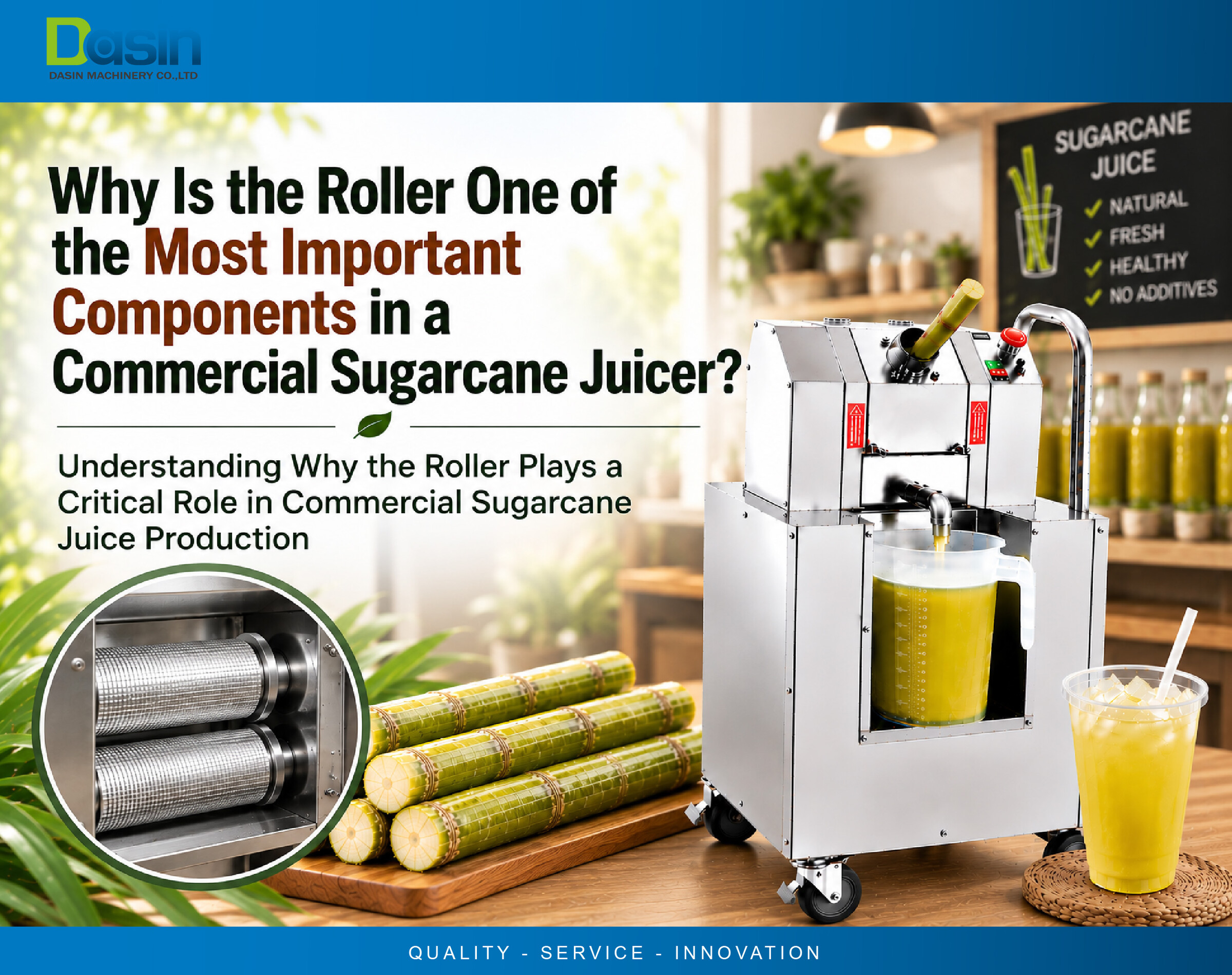
Why Is the Roller One of the Most Important Components in a Commercial Sugarcane Juicer?
DASIN sugarcane squeezer, different from traditional sugarcane juicer with exposed rollers, for sake of health, the machine is designed with protecting cover to prevent dust or insects from contacting with rollers. For safe operation, machine is designed to automatic power off while removing protecting cover.
Stronger 304 stainless steel solid roller with higher durability is adapted to improve juice yield.
Why Is the Roller One of the Most Important Components in a Commercial Sugarcane Juicer?
Understanding Why the Roller Plays a Critical Role in Commercial Sugarcane Juice Production
The Roller Does More Than Crush Sugarcane—It Supports the Entire Production Process
Among all the visible components of a commercial sugarcane juicer, the roller is often the first feature people notice.
Many first-time buyers naturally ask questions such as:
● How many rollers does the machine use?
● What material are the rollers made from?
● Which roller design performs best?
These are all reasonable questions.
However, from a commercial equipment perspective, a more important question is:
Why is the roller considered one of the most critical components of a commercial sugarcane juicer?
The answer extends far beyond juice extraction.
The roller performs the machine's primary processing task while working together with the drive system, power transmission system, food-contact components, and overall operational workflow.
Understanding the roller therefore means understanding how commercial equipment achieves stable, repeatable performance throughout daily business operation.
The Roller Performs the Equipment's Primary Processing Function
Commercial sugarcane juicers are designed to repeat the same production process continuously throughout the working day.
From feeding sugarcane into the machine to extracting juice and discharging the remaining fiber, every stage must operate consistently.
Within this production process, the roller performs the machine's primary processing function.
Its role is not limited to crushing sugarcane.
It must also work in coordination with the entire equipment system to maintain a smooth, continuous production flow.
For this reason, the roller should be viewed as a key part of an integrated operating system rather than an isolated mechanical component.
Roller Design Influences More Than Juice Extraction
It is easy to assume that the roller exists only to extract juice.
In reality, roller design may influence several aspects of commercial operation, including:
● Stable sugarcane feeding
● Consistent extraction performance
● Continuous production flow
● Cleaning accessibility
● Routine maintenance efficiency
● Long-term operational stability
As a result, the value of the roller extends well beyond extraction performance.
Its design contributes directly to the overall efficiency and reliability of commercial production.
Different Equipment May Use Different Roller Designs
Commercial sugarcane juicer manufacturers often adopt different engineering approaches when designing roller systems.
Some prioritize production efficiency.
Others emphasize easier maintenance.
Certain manufacturers develop roller configurations to support specific industries or commercial operating environments.
Because equipment is designed to solve different operational challenges, there is rarely a single roller design that is universally superior.
Instead of searching for the "best" roller, businesses should evaluate how each design supports their specific operational requirements.
The Roller Creates Value by Working with the Entire Equipment System
Although the roller is one of the most important components inside a commercial sugarcane juicer, it cannot perform independently.
Its performance depends on coordination with multiple equipment systems, including:
● Power delivery
● Drive transmission
● Machine structure
● Operator workflow
● Maintenance planning
Each system influences the effectiveness of the roller during daily operation.
For this reason, evaluating roller performance requires looking beyond individual specifications and understanding how the complete equipment system functions as an integrated whole.
This systems-based approach is one of the defining characteristics of commercial food processing equipment.
Understanding the Roller Is an Important Step Toward Understanding Commercial Equipment
For many businesses, the roller represents the first opportunity to understand how commercial equipment is engineered.
Although it appears to be a single mechanical component, it connects directly to the machine's most important production processes.
Once businesses understand how the roller interacts with the entire equipment system, it becomes much easier to recognize why different commercial sugarcane juicers are designed differently and how those designs support different operating environments.
Dasin Insight
Through years of collaboration with beverage brands, food manufacturers, distributors, and international business partners, Dasin has observed growing interest in the engineering behind commercial equipment.
Rather than focusing only on production capacity or external appearance, more businesses now seek to understand the critical components that determine long-term operational performance.
Among these components, the roller is consistently recognized as one of the most important.
From our perspective, its value lies not only in extracting sugarcane juice, but in how effectively it works together with the complete equipment system to support stable, efficient, and reliable commercial production.
Note: The observations above are based on Dasin's practical experience working with beverage businesses, food manufacturers, equipment distributors, and international customers, rather than market survey data.
Global Market Insight
Across the commercial food equipment industry, engineering priorities continue to shift from maximizing individual component performance toward improving complete system integration.
Within commercial sugarcane juicers, the roller remains the primary processing component.
However, manufacturers increasingly evaluate how roller systems interact with power transmission, machine structure, sanitation, and maintenance systems to improve operational stability and long-term performance.
This reflects a broader trend toward systems engineering rather than component optimization alone.
Frequently Asked Questions
● Why is the roller considered one of the most important components in a commercial sugarcane juicer?
Because it performs the machine's primary processing function while working closely with the drive system, machine structure, and overall production workflow. Its performance directly affects operational consistency.
● Does the roller only affect juice extraction efficiency?
No.
Roller design may also influence production stability, cleaning accessibility, maintenance efficiency, and long-term commercial operation.
● Should buyers compare only roller specifications when evaluating equipment?
Not necessarily.
The roller is an essential component, but it should be evaluated together with the complete equipment system, business requirements, and intended operating environment.
Key Takeaways
● The roller is one of the most critical processing components in a commercial sugarcane juicer.
● Its role extends beyond juice extraction to supporting overall operational performance.
● Different manufacturers may adopt different roller designs to address different commercial applications.
● Roller performance depends on coordination with the complete equipment system.
● Understanding the roller provides deeper insight into how commercial sugarcane juicers are engineered for continuous business operation.
Continue Reading
After understanding the role of the roller, the next step is to explore another critical aspect of commercial sugarcane juicer design—food-contact components.
Because commercial sugarcane juicers come into direct contact with sugarcane and fresh juice every day, food-contact design plays an important role in sanitation, cleaning efficiency, equipment maintenance, and long-term operational management.
- Related Products
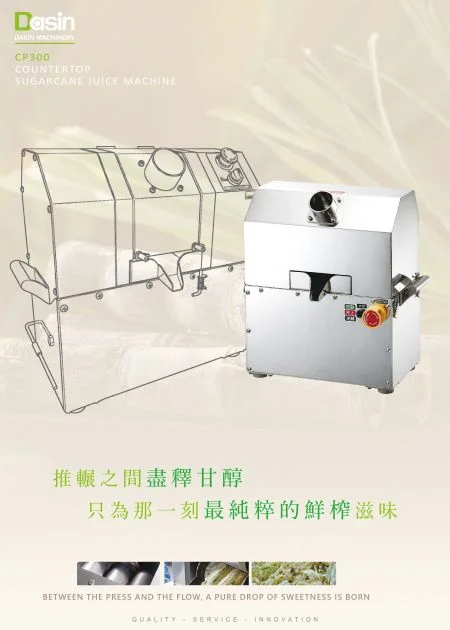
CP300 Countertop Sugarcane Juice Machine
CP300
DASIN desktop sugarcane squeezer, different from traditional sugarcane juicer with exposed rollers, for sake of health, the machine is designed with protecting...
Details Add to List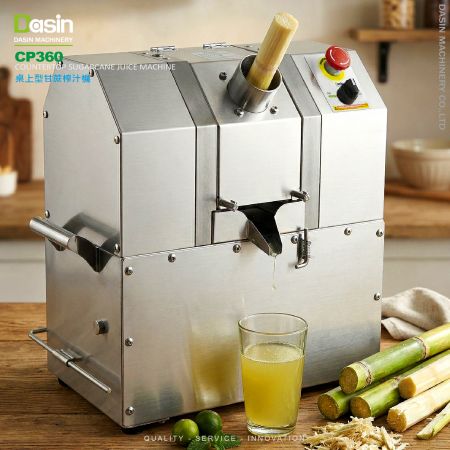
CP360 Countertop Sugarcane Juice Machine
CP360
DASIN desktop sugarcane squeezer, different from traditional sugarcane juicer with exposed rollers, for sake of health, the machine is designed with protecting...
Details Add to List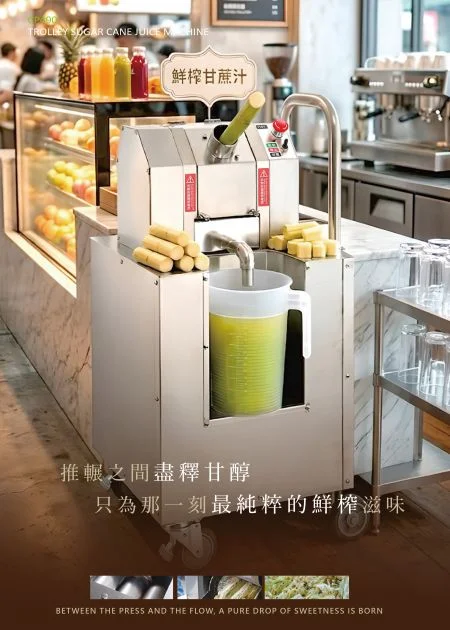
CP490 Trolley Sugar cane Juice Machine
CP490
DASIN trolley sugarcane squeezer, easy to move around, different from traditional sugarcane juicer with exposed rollers, for sake of health, the machine...
Details Add to List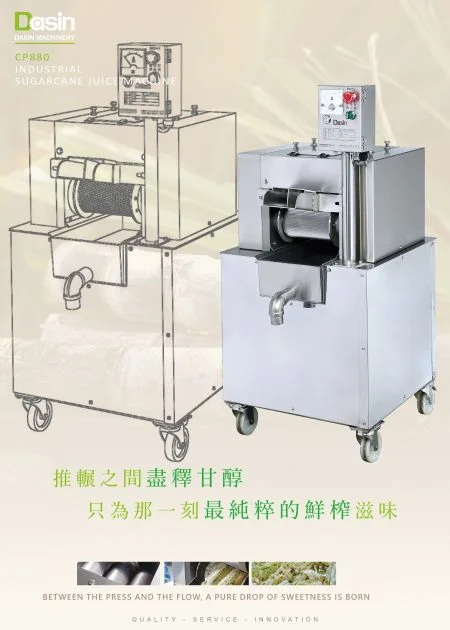
CP880 Industrial Sugarcane Juice Machine
CP880
DASIN Sugarcane Squeezer for Factory Use, six stainless steel rollers for three times of continuous squeezing for best juice yield, different from traditional...
Details Add to List
Popular Products
 Download
 Why Is the Roller One of the Most Important Components in a Commercial Sugarcane Juicer? | Made in Taiwan Commercial Juicers & Shaking Machines for Beverages and Drinks Manufacturer | Dasin Machinery Co., Ltd.
Located in Taiwan since 2010, Dasin Machinery Co., Ltd. has been a food machinery manufacturer. Their main products, including Commercial Juicers, Shaking Machines for Beverages and Drinks, Powder Dispensers, Industrial Juicers and Commercial Tapioca Pearls Machines with ISO 9001 certification.
Dasin Machinery is located in Caotun, Nantou, Taiwan, which is a professional manufacturer of food machinery. Our company was called Shengfa Food Machinery in early times, which started to produce commercial juicers and do OEM since 1975. We continually accumulate our experience in OEM and ODM. Meanwhile we constantly develop new products to fulfill the needs of our customers. Over 40 years of designing and manufacturing experience for commercial juicers, 70% to 80% market share in juice factory and beverage store business of Taiwan.
Dasin has been offering customers high-quality beverage and drink commercial machines, both with advanced technology and 40 years of experience, Dasin ensures each client's demands are met.