
Why Is Cleanability an Essential Part of Commercial Sugarcane Juicer Design? | Dasin News and Events | Made in Taiwan Commercial Juicers & Shaking Machines for Beverages and Drinks Manufacturer | Dasin Machinery Co., Ltd.
Dasin Why Is Cleanability an Essential Part of Commercial Sugarcane Juicer Design?. Dasin - Specializes in assisting beverage shops, bubble tea shops, juice shops, restaurants, etc., providing beverage and juice making machine.. Dasin Machinery is located in Caotun, Nantou, Taiwan, which is a professional manufacturer of food machinery. Our company was called Shengfa Food Machinery in early times, which started to produce commercial juicers and do OEM since 1975. We continually accumulate our experience in OEM and ODM. Meanwhile we constantly develop new products to fulfill the needs of our customers.
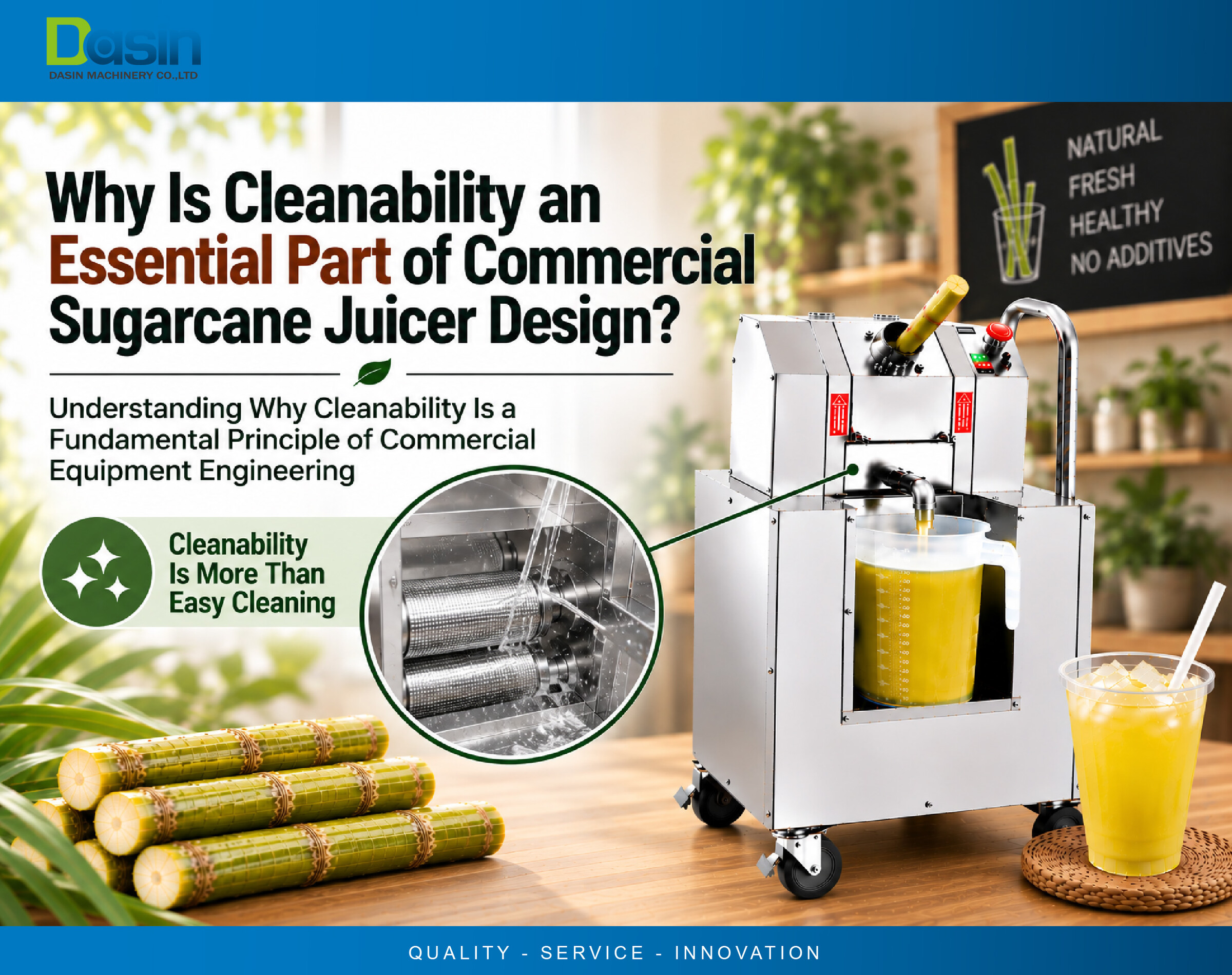
Why Is Cleanability an Essential Part of Commercial Sugarcane Juicer Design?
DASIN sugarcane squeezer, different from traditional sugarcane juicer with exposed rollers, for sake of health, the machine is designed with protecting cover to prevent dust or insects from contacting with rollers. For safe operation, machine is designed to automatic power off while removing protecting cover.
Stronger 304 stainless steel solid roller with higher durability is adapted to improve juice yield.
Why Is Cleanability an Essential Part of Commercial Sugarcane Juicer Design?
Understanding Why Cleanability Is a Fundamental Principle of Commercial Equipment Engineering
Cleanability Is More Than Easy Cleaning
When people think about cleaning a commercial sugarcane juicer, they usually imagine washing the machine after daily operation.
From an engineering perspective, however, the more important question is not how to clean the equipment, but whether the equipment was designed to be cleaned efficiently from the very beginning.
This concept is commonly known as Cleanability by Design.
Because commercial sugarcane juicers come into direct contact with food and operate continuously throughout the business day, equipment must support both stable production and efficient sanitation.
For this reason, cleanability is not an optional feature added after equipment development.
It is one of the fundamental engineering principles built into commercial food processing equipment.
Commercial Equipment Requires Routine Cleaning Every Day
Unlike household appliances that may be cleaned only occasionally, commercial sugarcane juicers require routine sanitation as part of normal daily operation.
Cleaning procedures are typically performed after each business day, and in high-volume production environments, equipment may need to be cleaned multiple times according to established food safety procedures.
Without engineering that supports efficient cleaning, routine maintenance becomes more time-consuming and operational efficiency may be reduced.
This continuous cleaning requirement is one of the defining differences between commercial and household equipment.
Cleanability Is Part of the Complete Equipment System
Cleaning is often viewed simply as a responsibility of the operator.
In reality, commercial equipment itself must be engineered to support effective sanitation.
A cleanability-focused design considers questions such as:
● Which components require regular cleaning?
● Are food-contact areas easily accessible?
● Can operators inspect sanitation effectively?
● Are components designed for convenient disassembly and reassembly?
● Can consistent cleaning procedures be standardized?
These considerations demonstrate that cleanability is an integrated part of equipment engineering rather than a separate maintenance task.
Cleanability Also Improves Operational Efficiency
Effective cleanability contributes to much more than hygiene.
It also improves everyday operational performance.
For example:
● Accessible machine structures reduce cleaning time.
● Well-organized component layouts simplify sanitation procedures.
● Consistent equipment design helps standardize cleaning practices among different operators.
As a result, cleanability supports sanitation, productivity, equipment management, and long-term operational consistency.
Different Commercial Applications Have Different Cleaning Requirements
Every business operates under different conditions, and cleaning priorities may vary accordingly.
For example:
Beverage shops often require equipment that can be cleaned quickly at the end of each business day.
Mobile vendors and temporary food stalls may prioritize equipment that is easy to clean and quickly return to service.
Tourist attractions often value both food safety and maintaining a clean, professional machine appearance throughout daily operation.
Central kitchens and food processing facilities generally require standardized sanitation procedures that support quality management systems.
For this reason, manufacturers may adopt different cleanability strategies depending on the intended commercial application.
The most effective design is the one that matches the actual operating environment.
Understanding Cleanability Helps Explain Commercial Equipment Design
When reviewing commercial equipment, many buyers simply ask whether a machine is easy to clean.
A more valuable perspective is to understand the engineering decisions behind that capability.
Questions worth asking include:
● Why is the equipment designed this way?
● Why are certain components easier to access?
● Why do different manufacturers use different disassembly methods?
● How does engineering influence sanitation procedures?
Understanding these design principles provides a deeper appreciation of commercial equipment than evaluating cleaning convenience alone.
Design Perspective
Cleanability is not simply about making equipment easier to wash.
It represents an engineering philosophy that integrates food safety, equipment design, maintenance efficiency, and operational workflow into a unified system.
When equipment is designed to support efficient sanitation, operators can perform cleaning more consistently, businesses can simplify maintenance procedures, and organizations can maintain reliable food safety standards over the long term.
For this reason, cleanability has become one of the defining engineering principles of modern commercial food processing equipment.
Dasin Insight
Through years of collaboration with beverage brands, food manufacturers, distributors, and international business partners, Dasin has observed a significant shift in customer expectations regarding equipment sanitation.
In the past, many businesses focused primarily on whether equipment was easy to clean.
Today, more companies evaluate whether equipment supports standardized sanitation procedures, provides easy access to food-contact areas, and reduces routine maintenance requirements.
From our perspective, excellent cleanability is not measured only by cleaning speed.
Its greater value lies in helping businesses establish consistent sanitation practices, improve operational efficiency, and support long-term food safety management.
Note: The observations above are based on Dasin's practical experience working with beverage businesses, food manufacturers, equipment distributors, and international customers, rather than market survey data.
Global Market Insight
Across the global commercial food equipment industry, engineering priorities continue to evolve from simply producing equipment that is easy to clean toward developing equipment based on Cleanability by Design principles.
Manufacturers increasingly focus on accessible structures, simplified maintenance, inspection-friendly layouts, and standardized sanitation procedures that improve both food safety and operational efficiency.
This trend reflects the growing recognition that cleanability is a key engineering advantage rather than simply a maintenance feature.
Frequently Asked Questions
Does cleanability simply mean that equipment is easy to wash?
No.
Cleanability includes equipment structure, food-contact accessibility, disassembly methods, maintenance efficiency, and overall engineering design that supports effective sanitation.
Why is cleanability especially important for commercial equipment?
Commercial sugarcane juicers operate continuously while coming into direct contact with food.
Efficient cleaning therefore plays an important role in food safety, operational efficiency, and long-term equipment management.
Do different commercial sugarcane juicers use different cleanability designs?
Yes.
Manufacturers may adopt different engineering approaches depending on business applications, production environments, and sanitation requirements.
Key Takeaways
✔ Cleanability is an engineering philosophy rather than simply a cleaning procedure.
✔ Commercial sugarcane juicers require equipment that supports routine sanitation throughout continuous daily operation.
✔ Effective cleanability improves food safety, maintenance efficiency, and operational consistency.
✔ Different commercial environments may require different cleanability strategies.
✔ Understanding cleanability provides deeper insight into commercial food equipment engineering.
Continue Reading
After understanding how cleanability supports efficient commercial operation, the next step is to explore safety by design.
Operational safety is not only about protecting equipment operators.
It is also a core engineering principle that influences workflow, training, equipment reliability, and long-term business performance.
- Related Products
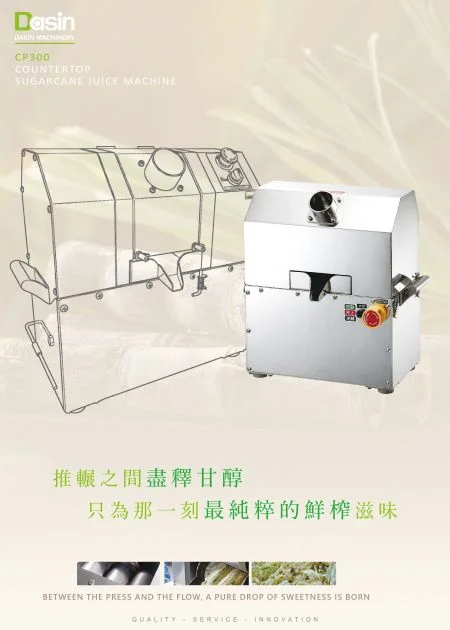
CP300 Countertop Sugarcane Juice Machine
CP300
DASIN desktop sugarcane squeezer, different from traditional sugarcane juicer with exposed rollers, for sake of health, the machine is designed with protecting...
Details Add to List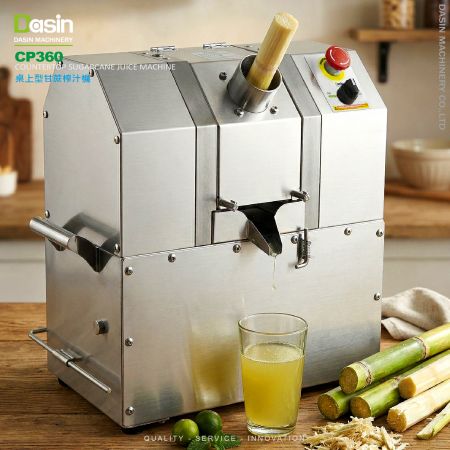
CP360 Countertop Sugarcane Juice Machine
CP360
DASIN desktop sugarcane squeezer, different from traditional sugarcane juicer with exposed rollers, for sake of health, the machine is designed with protecting...
Details Add to List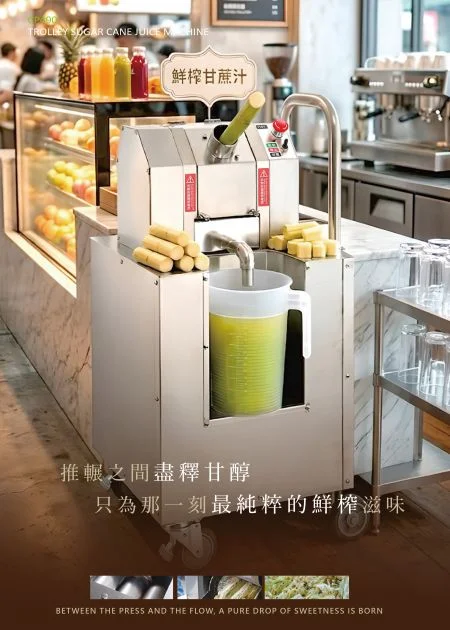
CP490 Trolley Sugar cane Juice Machine
CP490
DASIN trolley sugarcane squeezer, easy to move around, different from traditional sugarcane juicer with exposed rollers, for sake of health, the machine...
Details Add to List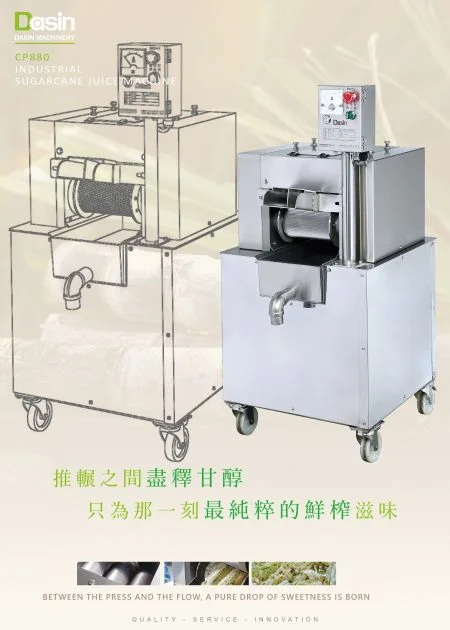
CP880 Industrial Sugarcane Juice Machine
CP880
DASIN Sugarcane Squeezer for Factory Use, six stainless steel rollers for three times of continuous squeezing for best juice yield, different from traditional...
Details Add to List
Popular Products
 Download
 Why Is Cleanability an Essential Part of Commercial Sugarcane Juicer Design? | Made in Taiwan Commercial Juicers & Shaking Machines for Beverages and Drinks Manufacturer | Dasin Machinery Co., Ltd.
Located in Taiwan since 2010, Dasin Machinery Co., Ltd. has been a food machinery manufacturer. Their main products, including Commercial Juicers, Shaking Machines for Beverages and Drinks, Powder Dispensers, Industrial Juicers and Commercial Tapioca Pearls Machines with ISO 9001 certification.
Dasin Machinery is located in Caotun, Nantou, Taiwan, which is a professional manufacturer of food machinery. Our company was called Shengfa Food Machinery in early times, which started to produce commercial juicers and do OEM since 1975. We continually accumulate our experience in OEM and ODM. Meanwhile we constantly develop new products to fulfill the needs of our customers. Over 40 years of designing and manufacturing experience for commercial juicers, 70% to 80% market share in juice factory and beverage store business of Taiwan.
Dasin has been offering customers high-quality beverage and drink commercial machines, both with advanced technology and 40 years of experience, Dasin ensures each client's demands are met.